

Find the right cement solution for your application in our range of high-performance cements. Whether you're looking for bulk cements, reduced carbon cements, or bagged cements, we offer solutions to suit different needs.
Our product range includes Portland cement (CEM I), blended cement (CEM II and CEM III), and white cement. We also supply specialist cement, from cement for conservation work to evoZero, the world’s first carbon captured near-zero cement, ensuring the right solution for every project.
We produce our cement at our three plants across the UK, ensuring a reliable supply of cement to the construction sector. As a leading global cement manufacturer, we’re equipped to supply both large- and small-scale construction projects across the country with a full range of cement products.
Explore cement from Heidelberg Materials UK below. For more information or technical assistance, please get in touch.
Our cement range
We produce a variety of cement for use across construction projects of all scales and sizes - and to meet a range of specifications. Our cement is regularly tested to BS EN 197 to ensure its quality.
Read about the different types of cement we offer below. For support in finding the right solution for your application, please contact our technical team.




Lower carbon cement and cement alternatives
We offer a growing range of innovative products that reduce clinker content in cement and accelerate progress towards net-zero construction, including supplementary cementitious materials.
evoZero
We’re the first company in the world to offer carbon captured near-zero cement, known as ‘evoZero’. We use carbon capture and storage (CCS) technology to produce evoZero in Brevik, Norway, with large-scale evoZero production coming to our new CCS plant in Padeswood, north Wales, in 2029.
evoBuild low carbon GGBS
evoBuild low carbon GGBS (ground granulated blast furnace slag) is the tried and tested cement alternative for delivering and meeting sustainable construction goals in any concrete mix.
The cement substitute’s low carbon footprint significantly reduces the environmental impact of a project, while maintaining the strength and durability of a high-quality concrete. When one tonne of evoBuild low carbon GGBS is used in concrete instead of one tonne of Portland cement, an embodied carbon dioxide reduction of around 650kg can be achieved.
Carbon accounting
It's well known that the production of cement is carbon intensive, largely due to unavoidable process emissions from calcination and fuel combustion during clinker production. As a result, the only way to produce this essential construction material without emitting large amounts of carbon is to capture and store these emissions before they enter the atmosphere.
Read the article by Nina Cardinal, our Technical Strategy Director, to understand the importance of carbon accounting when specifying evoZero.
Cement delivery
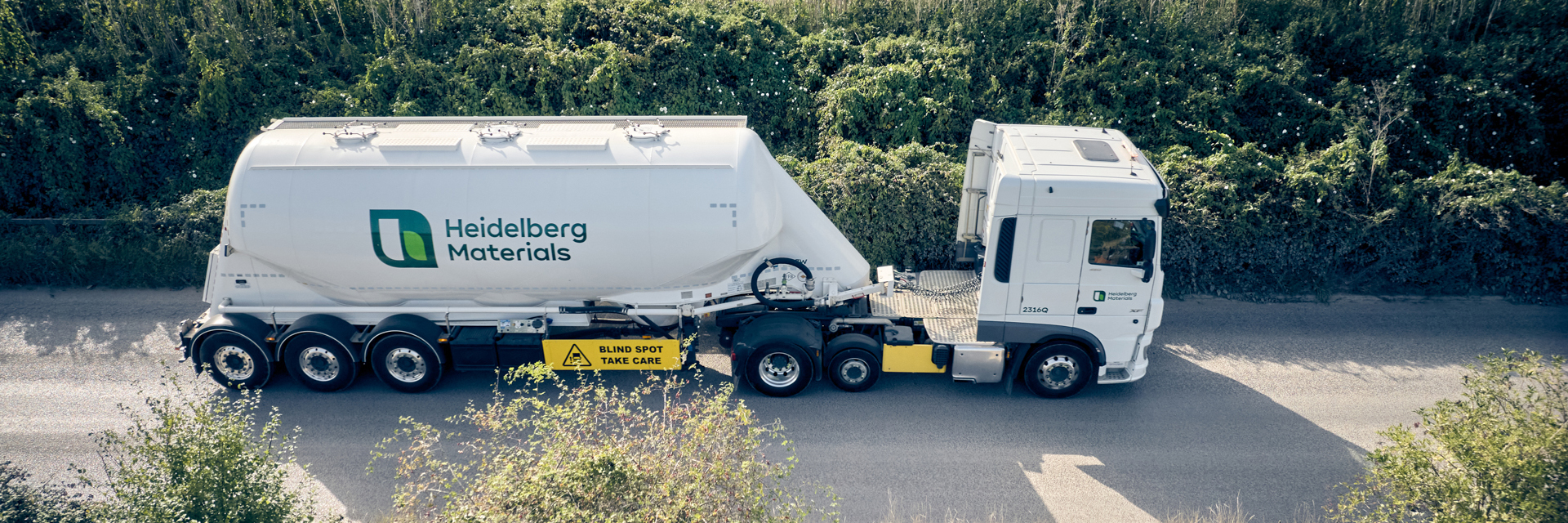
We manufacture our cement from three plants across the nation, located in Ketton, Padeswood, and Ribblesdale. Using a trusted fleet of tankers, we deliver cement nationwide to construction projects of all shapes and sizes. We use highly trained professional drivers and the latest vehicles to ensure safe, reliable, and efficient deliveries.
We offer flexible delivery windows to suit your needs, including next-day delivery, which is available for orders placed before midday.
If you have your own tankers, you may be able to collect bulk cement from some of our cement works, but you must adhere to our stringent safety procedures to do so. For more information or to learn about these procedures, please contact our team.

Why choose our cement?
✓ Quality-assured cement
All of our cement is regularly tested to BS EN 197 at our national laboratory in Scunthorpe. Our expert technicians have decades of experience and test 60 samples a day to ensure our cement is of the highest quality to meet your standards.
View our test data or learn more about our testing facility.
✓ Sustainable cement products
We lead the cement industry in applying carbon capture and storage technologies to cement production, as well as the use of GGBS.
✓ Dedicated sales support
We offer integrated sales management for seamless ordering and delivery.
✓ National delivery fleet
With 1,200 vehicles, 140 rail freight wagons, and four locomotives, we ensure a safe and reliable supply of cement across the nation.
Why trust Heidelberg Materials?
We supply high-quality cement products to the UK’s construction sector, from major infrastructure projects to local and DIY builds. With over 150 years of experience as part of Heidelberg Materials, our cement products are durable, reliable, and trusted by the industry.
Accreditation and certifications
All of our cement products are regularly tested and conform to BS EN 197. We’re also certified to ISOs 9001, 14001, and 45001.
Where our cement has been used
Hinkley Point C
We provided 215,000 tonnes of cement to Europe's largest construction project while developing new standards and systems to manage performance.
Canary Wharf, London
We supplied cement and other materials to build the UK's only floating ready-mixed concrete plant, which is supporting construction in the heart of London.
Hindhead Tunnel
Local cement from our Ketton plant was used in sprayed concrete to help build the 1.8km twin-bore tunnel beneath the Devil's Punch Bowl.
Sellafield
Up to 2,000 tonnes of GGBS are used every year at Sellafield to help the safe and efficient decommissioning of this nuclear power plant.
Ashton Canal Bridge, Manchester
evoBuild low carbon concrete containing 85 per cent GGBS has been supplied to help construct Ashton Canal Bridge in Manchester.
How cement is made
Learn how we make cement here in the UK by reading our technical article or watching our video below.
How cement is made
Sustainable building materials and services
We’ve designed our range of sustainable building materials and services to reduce carbon emissions, support circularity and deliver long‑term performance for the UK construction sector.
With the help of experts like Dr Nina Cardinal, we’re driving the adoption of innovative products like evoZero carbon-captured near zero cement and cement alternatives. Read about the benefits of using carbon captured cement or learn more about the specialists that make up our team by viewing our 'meet the experts' page.
evoHub
evoHub Greenwich is our practical learning environment where visitors get a hands-on approach to building their sustainability knowledge. Through product demonstrations, trials, and other events, it’s where you’ll gain a better understanding of how Heidelberg Materials is pioneering the decarbonisation of the construction industry.
For CPDs and seminars on decarbonising heavy building materials for construction, visit our evoHub in Clerkenwell.
Let's Talk Sustainability
Our ‘Let's Talk Sustainability’ series includes expert online and in-person events on a range of sustainability topics. These free events are designed to provide a clear and transparent view of Heidelberg Materials' approach to key sustainability issues within the construction sector.
They’re for everyone in the construction sector with an interest in the subject, including:
- Contractors
- Local authorities
- Highways professionals
- Architects
- Engineers
- Housebuilders
How to get in touch
Build smart with cement from Heidelberg Materials UK. Use the contact details or complete the form below to speak to our cement team, or click here to request a quote.
Useful contacts
To place a cement order:
- Email: cementorders@uk.heidelbergmaterials.com
- Call: 0330 123 4520
To speak to our cement customer service team:
Contact form
Cement FAQs
What is cement?
Cement is a binding material made from a mixture of limestone, clay, and other binding materials and additives. When mixed with water, cement hardens and acts as ‘glue’ to hold solid building materials like bricks and slabs together. As such, it’s a highly versatile building material that’s extremely valuable to the construction sector.
Applications of cement include:
- Foundations
- Walls and floors
- Paving and driveways
- Bridges and infrastructure
- Roads and motorways
What’s the difference between CEM I, CEM II, and CEM III?
CEM I is the traditional cement that’s been used in construction for many years. Sometimes referred to as Portland Cement (PC) or Ordinary Portland Cement (OPC), CEM I is primarily composed of Portland cement clinker, with other materials making up less than 5%.
CEM II and CEM III are Portland composite cements where a proportion of the cement clinker is replaced with one or more supplementary cementitious materials (SCMs). The use of SCMs gives beneficial properties to these cements in terms of both technical performance and sustainability.
Our CEM II cements are combinations of Portland Cement clinker and high purity, high fineness limestone (6-35% of total composition), which provide high performance and enhanced sustainability.
Our CEM III cements are combinations of Portland cement clinker and our evoBuild low carbon GGBS (36-70% of total composition), which have significantly reduced embodied carbon combined with several durability benefits.
How much cement do I need for my project?
The amount of cement you need depends on the type and size of your project, and the mix you're making. For example, different proportions of cement and other materials are required to make concrete, mortar, screed, and render. Our technical specialists can advise you on how to calculate the amount of cement you need.
Where are Heidelberg Materials UK’s cement plants located?
We have three cement plants in the UK:
- Ketton, Rutland
- Padeswood, north Wales - this is where we’re building the UK’s first carbon capture facility at a cement works
- Ribblesdale, Lancashire
How much does cement cost?
It depends on a variety of factors, from the location of the project and the volume of cement required to the lead time on particular mixes. For the most accurate price, please request a quote.
What’s the difference between cement and concrete?
Cement is a material that’s used to make concrete. It acts as the binder when aggregates (such as sand and gravel) are mixed with water, which then produces concrete.
How much cement do I need to make concrete?
The amount of cement required depends on the volume and required strength of concrete you’re making, as well as the mix design, including the aggregates being used. To understand how much concrete you need, use our concrete volume calculator. For support on calculating the amount of cement needed to produce this volume of concrete, get in touch with our technical team.
Do you supply specialist cement?
Yes. While standard cement suits most general construction tasks, we design and provide specialist cement for projects where specific performance characteristics are required. For instance:
- Greater durability
- Reduced embodied carbon
- High resistance to harsh environmental conditions
To learn more about our specialist cement offering or to request a quote, please contact our technical team.
How does Heidelberg Materials UK ensure the quality of its cement?
We regularly test our cement products to ensure their high quality. Based at our national testing laboratory in Scunthorpe, our expert technicians have decades of experience and test 60 samples a day to ensure cement meets your standards.
How strong is cement?
While cement is a strong and durable binding material, its strength depends on its type and how it’s mixed, placed, and cured. There’s also a difference between the strength of the cement itself and that of the finished material (for example, concrete or mortar). When selecting a cement, make sure you check that the product and mix meet your required specifications.
Is cement waterproof?
No. While some cement is water resistant, standard cement isn’t waterproof. If protection against water is critical to your application, choose a waterproof system or specialist materials. For advice on these types of materials, contact our technical team.
How should cement be stored?
To ensure your cement performs as intended, store it away from moisture and other products. If you’ve ordered cement in bulk, it’s essential that the product container is raised off the ground and covered with a waterproof lining to prevent moisture ingress.
How long does cement take to set?
Setting time depends on different factors, from the type and mix of cement used to temperature and moisture conditions. Please contact our technical services for more information on setting times.
How long does cement take to cure?
Like setting time, curing time depends on different factors, from the type of cement used, the application of the cement, and temperature and moisture conditions. For information on curing, contact us.
What’s the difference between bagged and bulk cement?
Bagged (also known as ‘packed’) cement is supplied in pre-packaged quantities. It’s ideal for smaller building projects and DIY jobs where cement can be stored and handled manually.
Bulk cement is supplied in much larger quantities. It’s suited to high-volume or commercial projects where significant amounts of cement are required.
Browse our range of packed cement or view our bulk cement products and services.