


One vision, one range
Our global evoBuild range is characterised by clear sustainability credentials.
The future of sustainable construction
evoBuild is our global brand for low carbon and circular cement, ready-mixed concrete, aggregates, and asphalt products. To qualify, every evoBuild product must meet strict qualification criteria. These standards ensure that only products with genuine sustainability benefits are included in the evoBuild portfolio.
Through evoBuild, we’re setting new standards for sustainable building materials and leading the construction industry towards net zero and a more circular economy.
About evoBuild products
All evoBuild products have clear sustainability credentials. Only products that are low carbon or circular, or that feature a combination of both attributes, are included in the range.
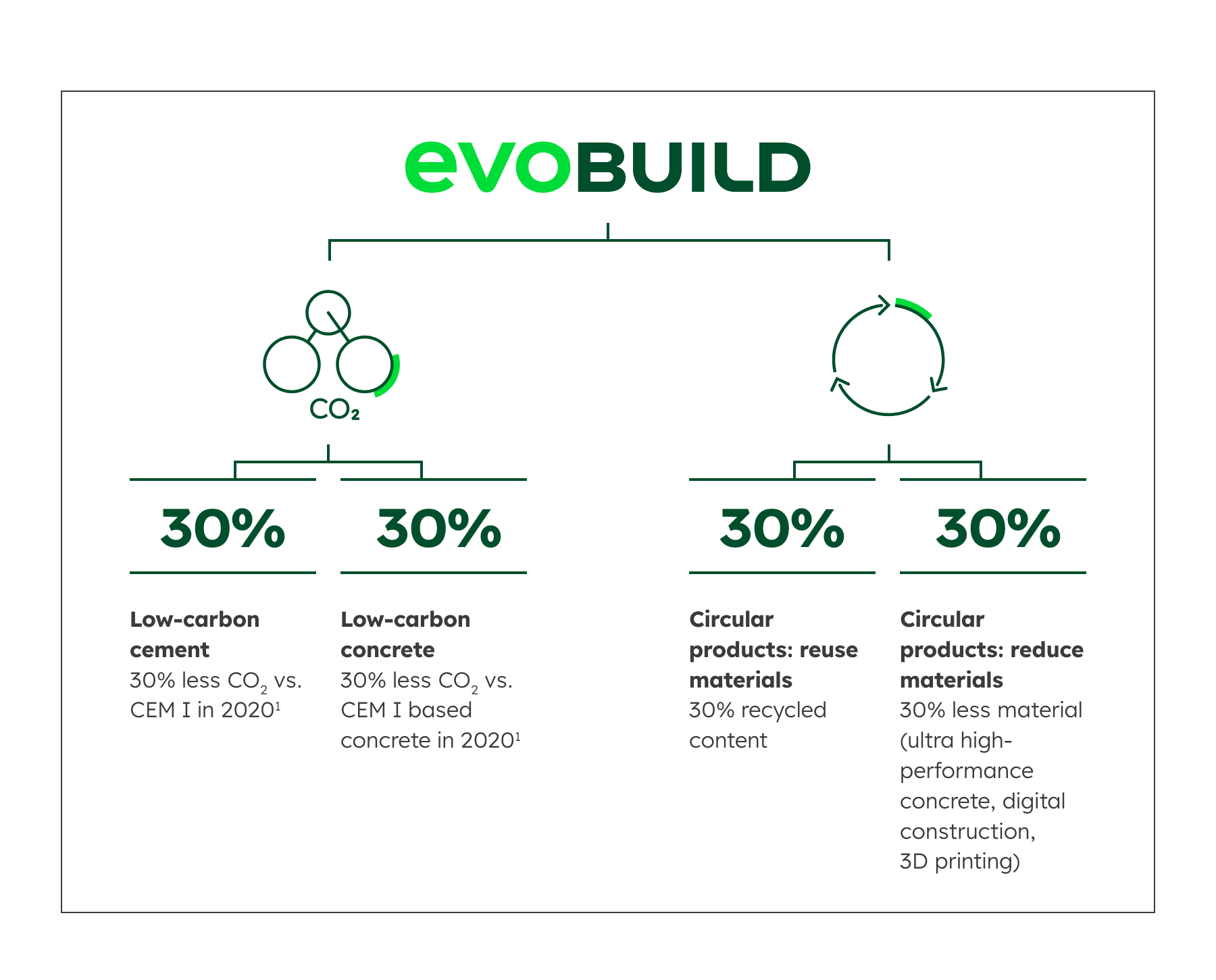
Low carbon: Delivers at least a 30% reduction in CO₂ emissions compared to standard reference values*.
Circular: Incorporates a minimum of 30% recycled content or reduces material requirements by at least 30%.
For confidence in materials that contribute to a more sustainable construction industry, choose evoBuild.
*The evoBuild reference value is at least 30% in CO2 reduction vs the global reference values from the Global Cement and Concrete Association (GCCA) for CEM I from 2020, which translates to ≤552 kg CO2/tonne cementitious material and ≤ 5.5 kg CO2/m3/MPa for ready-mixed concrete.
Article: Delivering carbon reduction in concrete
The world needs smart, sustainable and resilient infrastructure. But challenges like climate change and limited resources mean that the production and use of heavy building materials needs to evolve.

evoHub
Our evoHub is the place to learn about how heavy building materials are being decarbonised.


evoBuild Low Carbon Concrete
Our low carbon concretes offer a CO₂ reduction of at least 50% compared to a fixed Global Cement and Concrete Association (GCCA) reference value*. It complies with BS 8500 and BS EN 206-1 and is 100% recyclable at the end of its life.

evoBuild low carbon GGBS
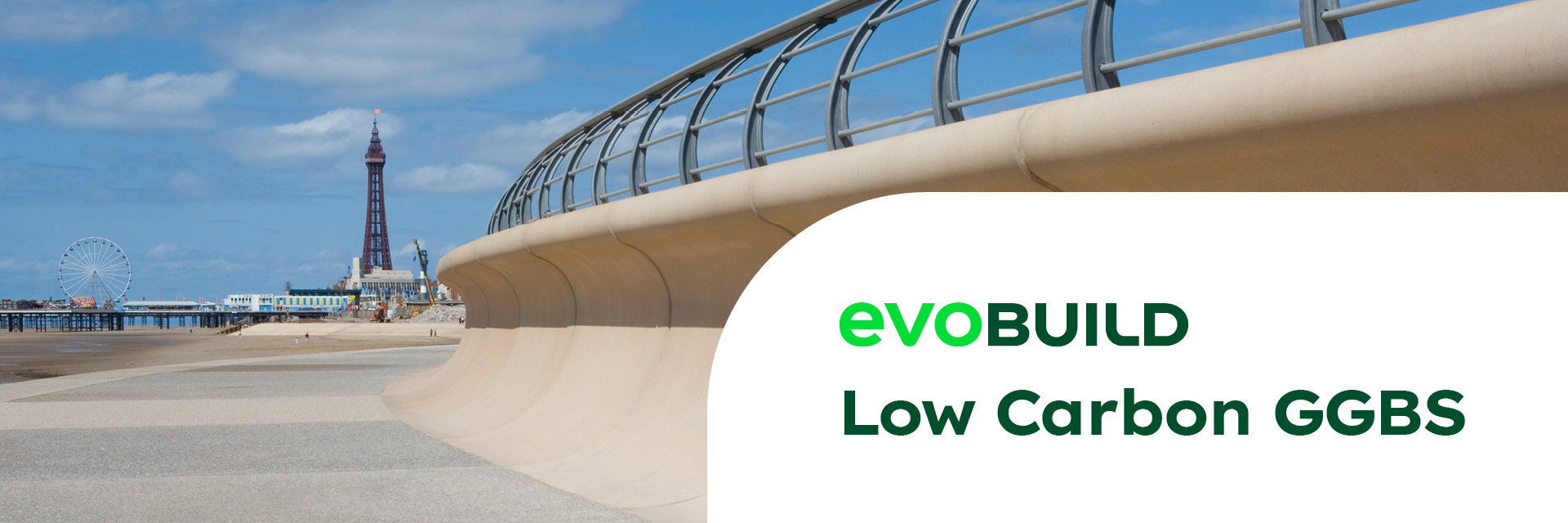
evoBuild low carbon GGBS is the tried and tested option for delivering and meeting sustainable construction goals in any concrete mix. Replacing one tonne of Portland cement with one tonne of evoBuild low carbon GGBS reduces embodied CO2 by around 650kg.


evoBuild foamed asphalt
evoBuild circular foamed asphalt is a cold mix asphalt containing up to 95% recycled materials, reclaimed fillers/additives, bitumen, cement, and water. It can reduce the carbon emissions associated with asphalt production and laying by a minimum of 40% when compared with conventional hot mix materials.
Raising standards, not emissions
High performance
Every evoBuild mix is designed to maintain strength, durability, and workability while reducing environmental impact.
Applications
All products are suitable for a wide range of projects, from infrastructure and residential buildings to specialised industrial flooring.
Availability
Our extensive UK fleet and plants ensure a consistent and reliable supply of evoBuild concrete nationwide.
How we classify our low carbon building materials
We’re the first company in the heavy building materials industry that uses globally standardised criteria to label sustainable products, including low carbon cement, recycled aggregates, and ultra-high-performance concrete.
The consistent evoBuild tiering is based on our sustainability strategy and significantly increases transparency towards our customers and stakeholders.
This is an important step towards achieving one of our key targets on the way to net zero as we aim to generate 50% of our revenue with sustainable products by 2030.
Dr Nicola Kimm, Chief Sustainability Officer
Products must comply with our internal ESG procedure, which sets out strict qualification standards. These standards ensure that only products with genuine sustainability benefits are included in the evoBuild portfolio.
CPD presentations
We can provide you with a full Continuous Professional Development (CPD) presentation on the specification and use of evoBuild low carbon GGBS and other cement substitutes in sustainable construction. Contact us below to request more information or to book a CPD presentation.
Other evo-products
Our wider evo-products are defining new standards for integrating sustainability into cement production and have set a pioneering benchmark for carbon capture.


evoZero
evoZero is the world’s first carbon-captured near-zero cement produced by Heidelberg Materials. We use carbon capture and storage (CCS) technology in Brevik, Norway, to achieve its near-zero status.
Production of evoZero cement will be possible in the UK by 2029 at our CCS facility in Padeswood, north Wales, delivering another significant milestone in the decarbonisation of the construction industry.
evoBuild FAQs
What are sustainable construction materials?
Sustainable building materials with the smallest possible carbon footprint are playing an increasingly important role for us and our customers. Our research and product innovation labs have developed various alternatives to traditional cement with reduced environmental impacts. These include cements and concretes with reduced carbon footprints, as well as building materials with characteristics that support the use of less materials. As a result, we’re enabling the construction sector and our wider society to implement climate-friendly solutions.
What are Heidelberg Materials’ goals for sustainable products?
As a global brand, our target is to generate 50% of global revenue through sustainable products by 2030. We introduced evoBuild, our global brand for low carbon and circular products, in October 2024 to help us reach this target - and simplify the specification of sustainable, high-performance building materials for our customers. evoZero carbon-captured near-zero cement is another one of our evo-products that is supporting our 2030 commitments.
Where has evoBuild been used?
Our low carbon materials have been used in numerous construction projects for a variety of applications.
- BAM Nuttall (on behalf of Network Rail) used evoBuild low carbon concrete to deliver crucial coastal protection works in Dawlish, Devon. With approximately 8,500m3 of evoBuild low carbon concrete used in the project rather than traditional concrete, carbon emissions associated with the concrete were reduced by two-thirds and more than 1.1k tonnes of CO2 were saved from entering the atmosphere (when compared with traditional concrete). For more information about this project, read: Concrete solutions for Dawlish sea wall.
- Up to 2,000 tonnes of evoBuild low carbon GGBS are used by Sellafield Ltd annually as part of a £3.2 billion nuclear decommissioning programme. The GGBS is used in the encapsulation process of waste streams from a thermal oxide reprocessing plant. GGBS accounts for 90% of the grout for the encapsulation process, with Portland cement as the remaining 10% Portland cement. For more details, view the case study.
- evoBuild foamed asphalt is primarily used in transport and infrastructure applications, including:
- Major and local highways
- Footways and cycleways
- Ports
- Housing developments
- Haunching and trenches
14,500 tonnes of evoBuild foamed asphalt was used to resurface 10 miles of the A47 Acle Straight near Great Yarmouth, resulting in a carbon saving of more than 400 tonnes of CO₂. Read the full case study.
What are BS 8500 and BS EN 206-1?
BS 8500 is the British Standard for specifying, producing, and ensuring the conformity of concrete. It was updated in 2023 to enable the use of cement substitutes such as GGBS, and sustainable, high-performance concrete mixes in construction.
BS EN 206-1 is the European Standard that applies to concrete for:
- Structures cast in situ
- Precast structures
- Structural precast products
It specifies requirements for elements including the constituent materials of concrete, limitations for concrete composition, and the properties of fresh and hardened concrete. evoBuild low carbon concrete meets both these standards.
Contact us
Fill out the form below for more information about evoBuild or to request a quote.