



Setting a new standard for sustainable construction
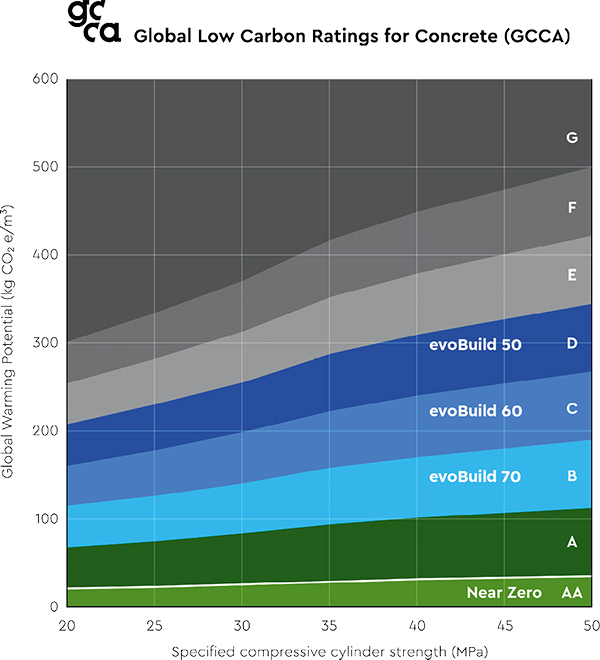
evoBuild low carbon concrete makes specifying more sustainable concrete easier and helps to target carbon reductions in construction. It offers a CO₂ reduction of at least 50% compared to a fixed Global Cement and Concrete Association (GCCA) reference value*. Currently available in three levels, all evoBuild low carbon concrete mixes offer the same quality and performance levels of traditional concrete, but with significant sustainability benefits.
The range
evoBuild low carbon concrete 50 | evoBuild low carbon concrete 60 | evoBuild low carbon concrete 70 |
|
|
|
Notes
All three levels have been benchmarked against the MPA's UK adoption of the GCCA Global Ratings for Low Carbon and Near Zero Concrete**.
Wherever possible, we use recycled water to produce evoBuild low carbon concrete, adding to its sustainability credentials.
*The evoBuild reference value is at least 30% CO₂ reduction vs. the global reference values from the Global Cement and Concrete Association (GCCA) for CEM I from 2020, which translates to ≤552 kg CO₂/t cementitious material and ≤ 5.5 kg CO₂/m3/MPa for ready-mixed concrete.
**Mineral Products Association. UK adaptation of Global Cement and Concrete Association (GCCA) Global Ratings for Low Carbon and Near Zero Concrete February 2025. NB Cement A1-A3 values reported as “Gross”.
Key benefits
- Reduces the carbon emissions associated with concrete by up to 70% against a fixed GCCA reference
- Easy to use and place
- Suitable for use in all applications, including reinforced and unreinforced concrete
- No change to the construction process
- Complies with BS 8500 and BS EN 206-1
- Creates concrete with a lighter, more aesthetically pleasing colour
- 100% recyclable at end of life, contributing to a more circular economy
Supporting informed decisions
We’re committed to providing our customers with the information they need to make informed decisions regarding carbon reduction. In 2023, Heidelberg Materials became one of the first heavy building materials manufacturers in the UK to reach the updated PAS 2080:2023 standard .
At the quotation stage for each evoBuild low carbon concrete mix, we can provide gross and net values of indicative global warming potential (GWP) in kg/CO₂/m³ for modules A1-A3***, so you can make informed choices regarding carbon reduction.
A post-delivery carbon scorecard can also be provided to allow you to track the total carbon contribution of the concrete to your build in kg/CO₂/m³ by product.
***The GWP values provided for evoBuild and the calculation process are third party verified as meeting the scope of EN 15804 modules A1-A3. Indicative values are provided, as mix designs and raw material GWP values can change over time.
Availability
evoBuild low carbon concrete is available from our network of static and mobile ready-mixed concrete plants across the UK.

Article: Delivering carbon reduction in concrete
The world needs smart, sustainable and resilient infrastructure. But challenges like climate change and limited resources mean that the production and use of heavy building materials needs to evolve.

Shaping low-carbon concrete
Discover how Dr. Daniel Clayton, and our dedicated team, are advancing decarbonisation through innovations like evoBuild low carbon concrete and the Power range, delivering practical solutions that combine performance and sustainability for tomorrow’s projects.
About evoBuild
A global approach to low carbon and circular products
Decarbonising building materials is key to creating the low and zero carbon infrastructure of the future. In October 2024 we launched evoBuild, our new global brand for low carbon and circular products. By setting new standards for sustainable building materials, the brand is helping us to promote a more circular economy within construction and lead the industry towards its 2050 net zero targets.
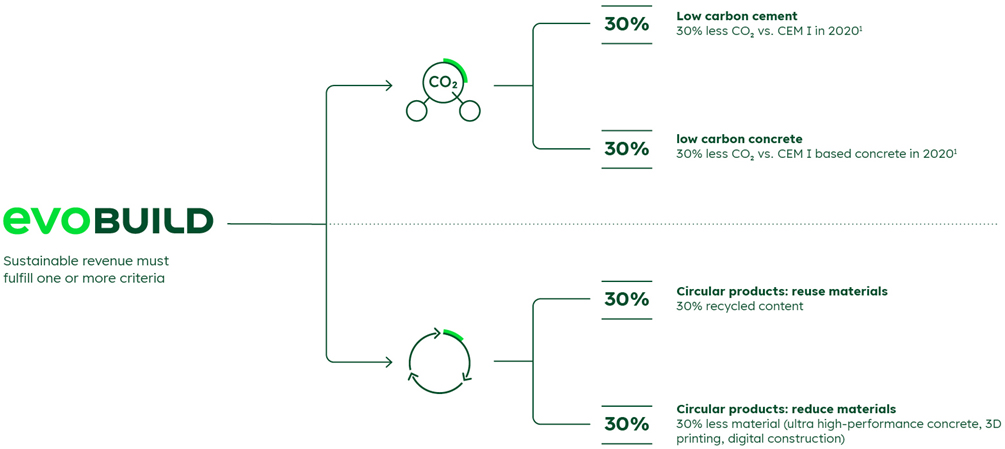
All evoBuild products are either low carbon or circular, or feature a combination of both attributes. Circular products must either contain at least 30% recycled content or reduce material requirements by at least 30%.
All evoBuild products have clear sustainability credentials and must meet strict requirements to become part of the range. The evoBuild portfolio includes cement, GGBS, aggregates, and asphalt products.
Other evo-products
Our wider evo-products are defining new standards for integrating sustainability into construction. They have set a clear and transparent benchmark within construction materials to build a more sustainable future.
evoZero

evoZero is the world’s first carbon-captured near-zero cement produced by Heidelberg Materials. We use carbon capture and storage (CCS) technology in Brevik, Norway, to achieve its near-zero status.
Production of evoZero cement will be possible in the UK by 2029 at our CCS facility in Padeswood, North Wales, delivering another significant milestone in the decarbonisation of the construction industry.
Contact us
How is evoBuild low carbon concrete different from traditional concrete?
When mixing concrete, if traditional CEM I (commonly called ‘Portland cement’ or ‘PC’) is replaced with our evoBuild low carbon GGBS, CO₂ emissions are reduced by a minimum of 30%. This results in evoBuild low carbon concrete, a sustainable alternative to traditional concrete.
The mix offers the same levels of strength and performance as standard concrete, as well as:
- Improving durability against chemical attacks
- Lowering the heat of hydration to prevent cracking
- Producing a lighter aesthetic
How does low carbon concrete help to reduce carbon emissions in construction?
By replacing CEM I (commonly known as ‘Portland cement’ or ‘PC’) in the concrete mix with evoBuild low carbon GGBS, a supplementary cementitious material, we’re able to produce a lower carbon concrete. PC requires clinker, the most carbon-intensive component of concrete, whereas evoBuild low carbon GGBS is a byproduct of the steel industry. The GGBS SCM helps to meet sustainable construction goals in concrete mixes by:
- Reducing waste that would otherwise go to landfill
- Reducing embodied CO₂ - one tonne of evoBuild low carbon GGBS can reduce embodied CO₂ by approximately 650 kg when used in place of one tonne of Portland cement
Which types of construction projects can low carbon concrete be used in?
Low carbon concrete is engineered to deliver the same strength, durability and performance as traditional concrete, while significantly reducing embodied carbon. Because of this, it can be used across all major construction projects, including: foundations, beams, bridges, tunnels, housing and commercial developments.
Are there any specific standards or certifications that low carbon concrete needs to meet in the UK?
Low carbon concrete used in the UK must comply with the same core performance, safety, and durability standards as conventional concrete. BS 8500 is the complementary British Standard to BS EN 206, providing UK‑specific guidance for specifying and producing concrete. Updates to these standards now include a broader range of SCMs to help achieve lower carbon concrete, whilst still meeting essential requirements for strength, durability, exposure classes, testing and production control.
What is the PAS 2080:2023 standard?
PAS 2080:2023 is a standard from the BSI Group (British Standards Institution). It specifies the requirements for the management of whole-life carbon in buildings and infrastructure, by:
- Guiding the management of carbon across the lifecycle of buildings and infrastructure
- Emphasising early collaboration, defined roles, and integrated decision-making for sustainability
Implementing PAS 2080 offers several benefits to construction projects, from lowering project costs and emissions to showing a commitment to decarbonising the built environment. We were one of the first UK heavy building materials manufacturers to reach the updated PAS 2070:2023 standard in 2023.