PowerSand is our cement bound sand (CBS) and has been specifically designed to protect energy infrastructure and storage. All products in our CBS range aim to reduce energy loss in the network, lower cable requirements, and cut costs and human power during installation.
With a 14:1 sand-to-cement ratio, our cement bound sand effectively conducts heat away from low- and high-voltage cables. With CBS from us, you can ensure safe, efficient electricity transmission while minimising energy loss.
You will also feel compliance confidence, as our cement bound sand products comply with Energy Network Association Technical Specification (ENA TS) 97-1 and cut costs over the lifespan of the project.
View our range of PowerSand mixes below and please get in touch for more information.
What applications can cement bound sand be used for?
Our cement bound sand is primarily used across energy, rail, and utilities projects. It’s designed to support the following applications:
- Cable bedding — Cement bound sand is crucial for Energy Networks Association (ENATS)* compliant projects.
- Trench stabilisation projects — CBS is used to protect and manage heat in utility trenches, such as high-voltage cabling.
*The product is classified as non-traditional as a part of the ENA TS 97-1 requirements. Compliance relies on the material source, please check with the technical team.
Benefits of CBS
Choosing us as your cement bound sand supplier means you have access to our PowerSand product range, which offers a variety of benefits to energy projects:
- Easily compacting around power cables
- Conduction of heat away from the source
- Electrical resistance prevention
- Our cement bound sand’s thermal resistivity is lower than CBS from other suppliers, too.
Request a quote
Our cement bound sand products
We’re proud to offer two different CBS products: PowerSand CBS and PowerSand CBS Extra. These are part of our Power range of products, alongside PowerCrete, our most high-performing heat-conducting concrete.
Use the table below to understand which Power product is best suited to your energy project.
| Product name | Description | Benefits |
| PowerSand CBS | PowerSand is a specialised backfill material for power cable installations. The certifies cable sand, which is ENA TS 97-1 compliant, is suitable for installation and backfilling of underground high voltage cables. | • Primarily used in rail, energy, and utilities projects, meeting all thermal property specifications
• Easily compacts around power cables to effectively conduct heat away from the source and prevent electrical resistance |
| PowerSand CBS Extra | Heidelberg Materials PowerSand CBS Extra is a non-traditional stabilised backfill as defined in ENA TS 97-1, with optimised performance. | • Lower thermal resistivity to traditional CBS
• Reduced carbon footprint |
| PowerCrete® | PowerCrete® is a robust, higher performing option compared to PowerSand. It is a heat-conducting concrete, used as a bedding and infill material for underground HV and UHV cabling. The special material properties of PowerCrete® result in low heat transmission resistance. | • Improved heat dissipation for HV and UHV cables
• High heat conduction after drying
• Reduction in magnetic field strength for alternating current
• Increased power capacity
• Reduction of conductor cross-section
• Switch to aluminium conductors possible
• Mitigation of “hot-spots”
• PowerCrete® has a thermal resistivity measured at 0.35 (K.m)/W
|
Where PowerSand has been used
Uskmouth Sub-Station
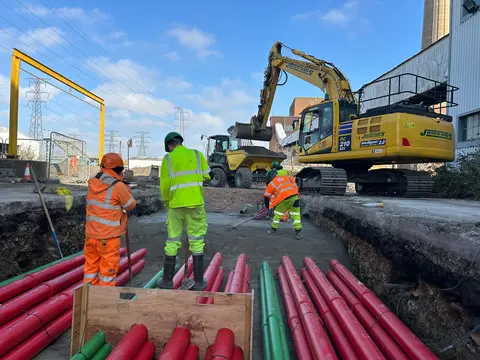
Heidelberg Materials supplied low carbon PowerSand CBS Extra to support cable installation at the new Uskmouth battery storage facility—helping transform a former coal site into a hub for clean energy.
Case study: Uskmouth Substation
Our accreditations
Heidelberg Materials fully conforms with ENA Technical Specification 97-1 and all our products carry this certification.
From the experts: CBS
“Heidelberg Materials’ PowerSand CBS Extra provided the performance we needed for safe and efficient cable installation, and their team was incredibly responsive throughout.
“Coordinating deliveries across two supply sites while adapting to evolving site conditions was no small feat, but their proactive approach and technical support helped keep the project on track.”
Rhys Roberts, Contract Manager at Jones Bros Ruthin Civil Engineering Ltd


 Quality-Assured Concrete
  Bespoke Concrete Products
  Dedicated Sales Support
  National Delivery Fleet