

At Heidelberg Materials, we continue to explore new approaches to low carbon road construction. At our Criggion asphalt plant in mid-Wales, we produced asphalt using 100 per cent hydrogen as the fuel for the first time in the UK.
This is a milestone in our journey to net zero. By replacing traditional fossil fuels with low carbon hydrogen, we demonstrated at industrial scale, that asphalt production can be cleaner and efficient, without compromising on product performance.
Our Criggion plant operated as a live pilot, demonstrating what the future of asphalt manufacture and road materials could look like. During the trial, the plant was designed and operated with a hydrogen compatible burner system and an advanced safety control system, enabling us to:
- Cut production emissions – hydrogen combustion produces cleaner flue gases, made up mostly of water vapour.
- Produce lower carbon asphalt – using hydrogen instead of natural gas as the primary fuel for drying and heating aggregates significantly reduces process emissions during production.
- Build in flexibility – our tri-fuel burner system can run on 100% hydrogen, liquefied petroleum gas (LPG), hydrogen–LPG blends, or Processed Fuel Oil (PFO), giving resilience as energy systems evolve.
- Built-in system resilience – the upgraded functional and operational safety systems have future‑proofed the plant for the use of gaseous fuels.
For highways clients, designers, contractors and local authorities, this project shows what is possible: lower carbon asphalt production at scale, with no compromise on performance.
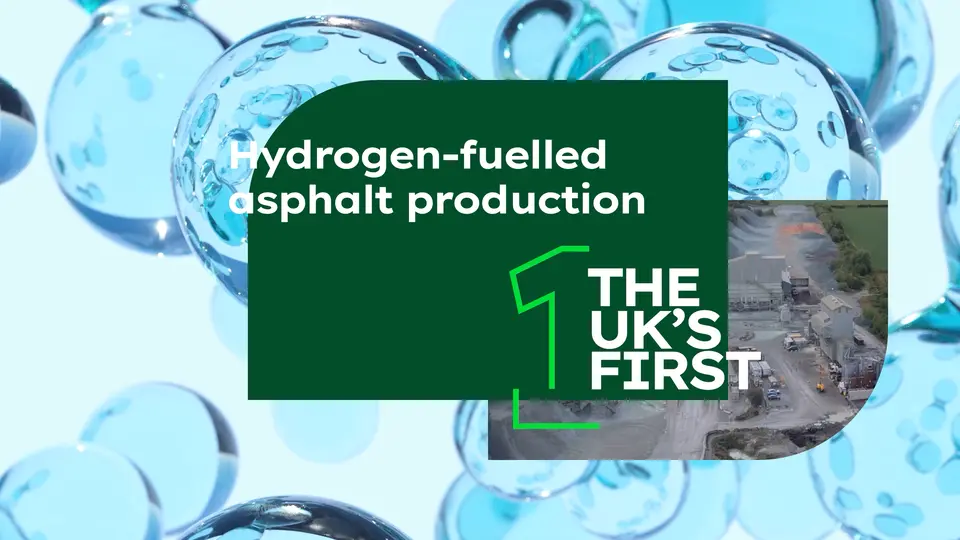
In July 2025, Criggion asphalt plant produced the UK’s first 20 tonnes of asphalt manufactured using 100 per cent hydrogen as the fuel.
This milestone reflects years of collaboration, investment and determination. Key contributors include:
- Ryze Power – supplying low carbon hydrogen for the Criggion trial.
- Vulcan Asphalt Group – developing, testing and supplying the hydrogen compatible burner system.
- Addison Project, CNG Services, FT Gas Control, Gexcon and CSL – providing engineering design, construction management, gas systems, safety expertise and hydrogen infrastructure.
This blend of expertise has taken the project from concept to a fully operational hydrogen fuelled asphalt production in under three years, successfully delivering a first of a kind UK demonstration. A great achievement to all involved.
Asphalt is durable, 100% reusable and recyclable.
Asphalt is one of the world’s most recycled materials. It is used as the surface for 95 per cent of our roads – as well as for playgrounds, footways, car and lorry parking areas, airport runways and much more – it is uniquely versatile. It is also an essential material for ensuring the safe and efficient transportation of goods and people on motorways and local roads across the country.
Our high-quality asphalt solutions have been developed to be the ideal choice for a wide range of applications, from major civil engineering projects to domestic driveways and footpaths.

Criggion enabled our customers to deliver on their own sustainability and project delivery goals during the trial by offering:
- Lower carbon asphalt supply - Hydrogen fuelled production helps reduce the embodied carbon of road schemes, supporting net zero targets and emerging specification requirements.
- Support for whole life carbon reduction - When combined with warm mix asphalts, RAP and durable mix designs, hydrogen fuelled production forms part of a wider approach to cutting emissions over a road’s lifetime.
- Confidence in performance - All mixes produced at Criggion are designed to meet the same rigorous performance standards as conventional asphalt. This mean customers can adopt lower carbon options without re-engineering projects from scratch.
FAQs
What was the Criggion hydrogen‑fuelled asphalt demonstration?
The Criggion project was a demonstration using hydrogen to fuel asphalt production at our Criggion asphalt plant in mid-Wales. It became the first site in the UK to produce asphalt using 100 per cent hydrogen as the fuel. The trial proved that asphalt can be produced at an industrial‑scale using low‑carbon hydrogen instead of traditional fossil fuels.
How did hydrogen‑fuelled asphalt production work?
The process was:
- Low‑carbon hydrogen was delivered to site in high pressure gas tube trailers.
- The plant’s tri‑fuel burners were configured to run on hydrogen, by the upgraded control system managed closely within the plant’s control room.
- The hydrogen flame was used to dry and heat the aggregates and recycled asphalt plannings (RAP) in the batch heaters.
- Hot aggregates and RAP were mixed with bitumen to create asphalt.
- Finished asphalt was stored in insulated silos and dispatched to customers in the usual way.
There was no difference in the finished asphalt compared to the material produced using traditional fuels, except it had a lower carbon footprint.
Why was this project important for UK roads?
Our Criggion hydrogen project demonstrated what lower carbon road construction can look like in practice. By switching the plant’s burners from natural gas to hydrogen, we reduced CO₂ emissions while continuing to supply high‑performance asphalt for resurfacing projects in the area. It proved that cleaner production and reliable supply can go hand in hand, without compromise.
Does using hydrogen change the performance of the asphalt?
No. All mixes produced at Criggion were designed and tested to meet the same performance standards as asphalt made with conventional fuels. For clients, contractors and specifiers, the benefit was lower carbon production with no compromise on quality, durability or handling.
Can the plant still operate without hydrogen?
Yes. Criggion has a tri‑fuel burner system that can operate on:
- 100 per cent hydrogen
- Liquefied Petroleum Gas (LPG)
- Hydrogen–LPG blends
- Processed Fuel Oil (PFO) lite
This built‑in flexibility keeps supply secure while energy systems and hydrogen infrastructure continue to develop.