

Farms rely heavily on concrete to provide the strong, durable infrastructure that’s needed for housing livestock and daily activities. From stables and barns to milking parlours and tracks, concrete is found site-wide. When the right type of concrete is used, farmers reap the rewards: durable structures that pose minimal risk to animals and support efficient operations. Given that construction in farming (and the wider agricultural sector) is a long-term investment, which usually requires years of planning, it’s imperative that the concrete mix prioritises long-term performance.
Which concrete is most suitable for farming and agriculture?
Ground-bearing slabs on farms used for tracks, barn floors, stables, etc are subjected to heavy loads every single day. From the weight of livestock to the constant movement of vehicles (including HGVs), the slabs must have sufficient strength and crack resistance to prevent structural failure.
With its high load bearing capacities, concrete reinforced with steel mesh has been a popular choice for farming applications over the years. But since the early 2000s, concrete reinforced with synthetic macro fibres has become the more favourable option, saving time and money while still providing strength and performance to ensure long term durability.


Concrete volume calculator
Use our ready-mixed concrete calculator to select the best concrete for your project and work out the volume you require.
The difference between steel mesh and synthetic macro fibre reinforced concrete
An overview of the differences between the two types of reinforcement in relation to the farming and agricultural industries is detailed in the table below.
| Steel mesh | Synthetic macro fibres | |
| What is it | Steel bars or welded mesh that are embedded into the concrete. | Thousands of small fibres, like steel and polypropylene (a synthetic plastic) are mixed throughout the concrete. |
| Reinforcement type | Localised, with reinforcements placed in specific locations. | Distributed evenly throughout the mix. |
| Applications |
| |
| Size | Varies from 4mm to 10mm. (Due to its performance properties, steel mesh over 10mm thick is unlikely to be able to be replaced by fibres.) | Coarse, approximately 0.5 to 1.0mm in diameter and up to 65mm long. |
| Preparation |
|
|
| Installation |
|
|
| Cost |
|
|
Comparing the suitability of steel mesh and synthetic macro fibre reinforced concrete for farming
Both types of reinforcement offer the following benefits to concrete:
- Provides primary structural strength and high load-bearing capacities
- Carries tensile forces that concrete can’t on its own
- Controls larger cracks after they’ve formed to prevent structural failure
- Provides post-cracking strength to reduce the chance of structural failure
To improve these properties further, synthetic micro fibres can be used. They:
- Control microcracks early to reduce the risk of large cracks
- Improve toughness, impact resistance, and longevity
(Find more information about the difference between steel and polypropylene fibres in our article: The structural and environmental benefits of fibre reinforcement.)
However, time, effort, and cost are three factors that differentiate synthetic macro fibre reinforcement and steel mesh. Reduced danger to livestock is one of the nicher properties that makes polypropylene fibre reinforcement the standout choice for farm applications.
Steel fibres are essentially 50-60mm long pins. While the ends of these pins are flat, they’re only around 1mm thick. Any fibres that protrude from the pin’s surface are a danger to animals’ feet as well as vehicle tyres. If any loose steel mesh is left behind once the installation is complete, there’s a chance that animals could eat it, posing significant risks of internal injury, infection, and toxicity.
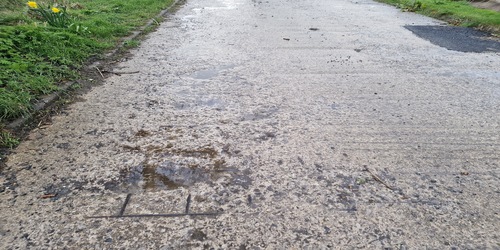
An example of concrete reinforced with steel mesh on a farm track
On the other hand, synthetic macro fibres are similarly sized (50-60mm) flexible plastics. If an animal’s feet or a vehicle’s tyres are exposed to them, they won’t be damaged. If eaten by an animal, the fibres will simply pass through it.
Find your local concrete team
Use our interactive map to see where your local customer support team is and get in touch with our concrete experts.
Concrete technical information
Explore technical information about our concrete solutions and find answers to common questions to ensure your project’s success.
How synthetic macro fibre reinforcement provides the strength that farming applications need
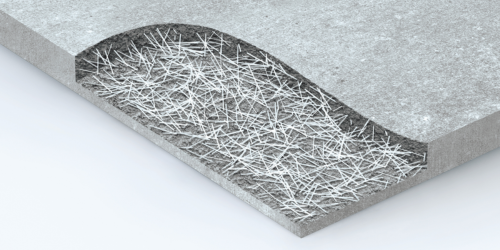
When synthetic macro fibres are added to a concrete mix, they distribute evenly throughout the mix. This creates a 3D reinforcement network, which adds strength and improves the concrete’s overall performance. The fibres also bridge micro-cracks, preventing them from developing into larger cracks, increasing tensile strength and durability. Given farms are under continuous pressure from heavy loads, synthetic fibre reinforcement is the ideal choice for hard-wearing, long-lasting concrete.
Common applications of synthetic macro fibre reinforcement in farming are detailed below.
Ground-bearing slabs
In ground-bearing slabs, synthetic macro fibre reinforced concrete performs the same function as steel mesh reinforced concrete: providing high load-bearing for vehicles and HGVs (tractors, tipper trucks, and milk tankers, for example).
Acidic spills
Synthetic fibres are less susceptible to chemical acid damage than steel fibres, which is the prime reason plastic fibres have been used on several food waste transfer slabs. However, it’s the cement in the concrete that’s most susceptible to chemical acid attacks.
At Heidelberg Materials, we supply a specialist Farm range of concretes, designed to withstand chemicals in agricultural environments.
For the most extreme exposure, Duracrete, our high durability concrete, and polypropylene macro fibres reduce the risk of damage. Standard, unspecialised mixes should withstand exposure to more common acids found on farms, like animal urine and faeces. However, we always add fibres to the mix so the concrete is strong, durable, and resistant to corrosion.
Slurries
British Standard and DEFRA approved concrete mixes are required for slurry applications. Every one of our farming mixes complies with these standards. We also incorporate synthetic macro fibres into the mix for the additional benefits of:
- Resistance to animal waste
- Ease of installation
- Longevity (macro fibres won’t corrode over time)
FarmTank is our specialist concrete that’s been developed for slurries and other waste management applications. Learn more about the mix by viewing our FarmTank page.
What’s the typical lifespan of fibre reinforced concrete for farming?
Specialist fibre reinforced concrete for agricultural use is heavy duty. It’s designed to withstand both vehicular and livestock traffic, as well as exposure to various chemicals and animal waste products. Unlike steel, it doesn’t corrode, a main cause of slabs needing to be replaced in agricultural environments. If the steel mesh is substituted for macro fibres, the lifespan of the slab will significantly extend, reducing maintenance costs in the long-term.
How expensive is concrete reinforced with synthetic macro fibres compared to steel mesh?
Concrete that’s reinforced with synthetic macro fibres typically costs around 20 per cent more than steel mesh. However, steel mesh is more intensive in terms of storage, installation, and labour than macro fibres, which brings additional costs. In real terms, using macro fibre reinforcement over steel mesh will save an average of over £1,000 on a 20m x 20m (400m2) slab using a fibre vs mesh calculator.
This cost saving, combined with improving the durability and overall lifespan of the concrete, demonstrates that synthetic macro fibre reinforcement is by far the best long term option for farming and agricultural applications.
Lee Baldwin, Head of customer technical support
More information
Our farming and agriculture page has an overview of the different types of concrete we supply to these industries. For more details about fibre reinforcement or to find the most suitable type of concrete for your site, please speak to our technical team.