We will reduce the carbon impact of our operations, with a science-based target of 15% reduction from a 2016 baseline
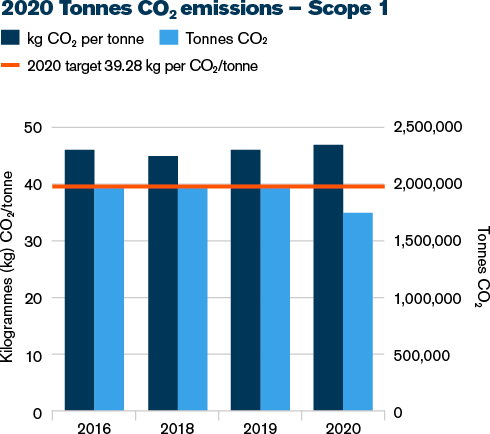
Carbon impact of our operations for Scope 1 emissions is up 3.5% from 46.21 kg CO2/tonne in 2016 to 47.84 kg CO2/tonne in 2020. When normalised to assume the same product mix ratio as the 2016 baseline, it shows a decrease of 6.5% to 43.19 kg CO2/tonne in 2020
Absolute thermal energy usage has dropped by 5.6% since 2016 and normalised thermal energy per tonne shows a decrease of 2.6% from 68.78 kWh/tonne in 2016 to 66.97 kWh/tonne in 2020.
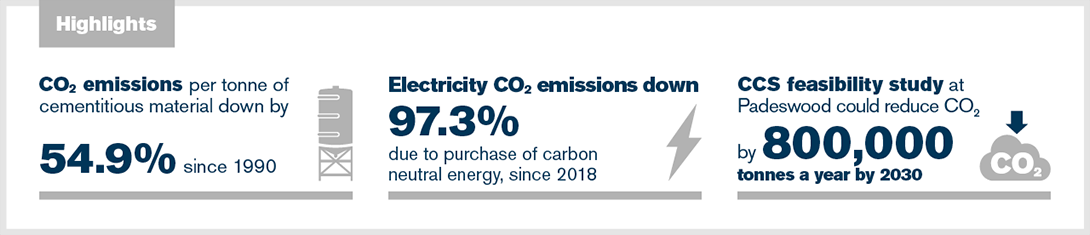
Scope 1 and 2 net CO2/tonne of cementitious material is down 54.9% from our 1990 baseline and down 18% from our 2016 baseline
Scope 2 emissions from electrical power consumption within our operations will be reduced by at least 65% compared to 2016
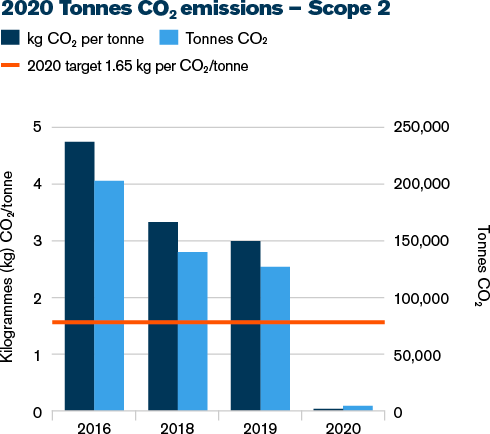
Our 2030 ambition has already been achieved as Scope 2 emissions are down 97.3% from 4.72 kg CO2/tonne in 2016 to 0.13 kg CO2/tonne in 2020, with normalised emissions down 97.5% to 0.12 kg CO2/tonne in 2020.
Absolute electrical energy usage has dropped 7.8% since 2016 and normalised electrical energy per tonne has decreased by 2.9% from 11.65 kWh/tonne in 2016 to 11.32 kWh/tonne in 2020.
100% of our car fleet and 50% of our van fleet will be fully electric or hybrid by 2025
38% of our car fleet is now hybrid or fully electric (up from 29% in 2019)
Trials of electric/hybrid vans will take place in 2021
We will collaborate with suppliers to enable our transport to be more efficient, including through new technologies for LGVs and heavy machinery such as site excavators, loading shovels and dumper trucks
We continue to explore the potential for new technologies for our fleets to reduce carbon emissions
From our cement operations we will reduce NOx by 40% and dust emissions by 80% from a 2008 baseline and maintain SO2 emissions below BAT (best available techniques) requirements
From the 2008 baseline in cement, SOx is up 20% but remains below the UK average and well below the best available techniques (BAT) guidelines level for new cement plants, NOx is down 11% and dust is down 62%
A new commitment to reduce CO2 emissions from downstream transportation (the transportation of materials from our sites to customers) by at least 15% compared to 2019
Overall aggregate tonnage moved by rail was less, as a result of decreased demand due to Covid-19, but was up to 27.5% of the total (up 2% compared with 2019)
CO2 emissions from downstream transport have reduced by 0.8% compared to 2019
Source of emissions explained
Scope 1: All direct emissions from the activities of an organisation or under its control, for example burning fuel on site in kilns and company-owned vehicles.
Scope 2: Indirect emissions from the generation of purchased electricity used by the organisation. These emissions are created during the production of the energy and eventually used by the organisation.
Scope 3: All other indirect emissions from activities of the organisation, occurring from sources that they do not own or control. These cover emissions associated with, for example, purchased goods and services, employee travel and commuting, waste disposal and leased assets.
As most of our sites use a zero-carbon electricity tariff, the reduction target of 65% has already been exceeded. We recognise we can do more than purchasing low or zero carbon electricity and that by reducing our own power consumption we can also reduce carbon emissions.
During the year we have been investigating opportunities for carbon capture and storage at our Padeswood cement works near Mold, Flintshire. We have since formally joined HyNet North West as a consortium partner. The project will play a critical role in the UK’s transition to net zero greenhouse gas emissions by 2050 through carbon capture at major industrial sites and the provision of low-cost hydrogen to other industries where carbon capture is not practical. The HyNet North West project will reduce regional CO2 emissions by up to 10 million tonnes – including up to 800,000 tonnes from our Padeswood plant – every year by 2030; the equivalent of taking four million cars off the road.
We are tackling the emissions from fossil fuels by continuing to use biomass wastes in our kiln fuels and are collaborating with researchers at Swansea University on a project to replace some of the natural gas used to power our Regen GGBS plant in Port Talbot, south Wales, with green hydrogen. A demonstration unit has been installed which produces green hydrogen through the process of electrolysis from rainwater, using renewable energy generated through solar panels and small wind turbines.
On a much larger scale, we are also working on a demonstration of a net zero kiln fuel mix at our Ribblesdale cement works in Clitheroe, Lancashire. This is part of a £6.2 million project being funded by the Department for Business, Energy and Industrial Strategy (BEIS) and has been awarded through the Mineral Products Association (MPA). It follows a BEIS-funded feasibility study in 2019, which found that a combination of 70% biomass, 20% hydrogen and 10% plasma energy could lead to cement and lime kilns operating with a net zero carbon fuel mix. We are replacing our current fossil fuels used in the kiln with hydrogen and biomass to assess the impacts on the process and product quality and performance.
In 2020 we introduced a new range of REA products to help minimise the impact of asphalt production and laying on local air quality. REA uses Shell Bitumen FreshAir, a specialist binder, which helps reduce emissions from asphalt mixes by an average of 40 per cent compared with conventional bitumen. It acts directly with some of the chemical compounds affecting air quality, as well as odour-releasing molecules, helping to cut NOx, SOx and particulate matter.
REA can be produced using our energy reducing asphalt (ERA) warm mix technology, which provides a significant reduction in CO2 emissions, providing a complete sustainable solution which reduces embodied carbon as well as emissions from the asphalt. This combination was specified by Tesco to resurface four of its customer car parks across the country in 2020. Using ERA realised a saving of 7,630kg of CO2 emissions, compared with conventional hot rolled asphalt, while the REA used is estimated to have a similar effect on particulate matter as planting 146 trees and a similar impact on the reduction of NOx as removing 366 cars from the road.